
road10.jpg)
The site of the coal wharf in 1983, by this time, the yard was mostly disconnected from the national rail, and the sidings had been lifted. The yard remained in use at this time for Co-op fuels and other merchants until its full closure in September 1983. Coal merchants huts are seen on the left.
Photo by Mark Smithers road11.jpg) The former station master’s house in 1983, as can be seen. It was left abandoned and unused at this time. The former up platform can be seen slightly to the left of the building.
Photo by Mark Smithers road12.jpg)
The former access to the up platform at Coundon Road station in 1983. The station master's house can be seen in front of the photographer with the level crossing lights on Coundon Road to the right. At this time, the station master's house has been left abandoned, as can be seen by the window and door on the building.
Photo
by Mark Smithers
road13.jpg)
The former station master's house at Coundon Road in 1983, at this time. The building looks to have been left abandoned, and the windows sealed up.
Photo by Mark Smithers road14.jpg)
Coundon Road signal box in 1983, it was still in operation at this time and had become one of the last active signal boxes on the national rail network in the Coventry area.
Photo by Mark Smithers road16.jpg) Inside the Coundon Road signal box in 1983. As can be seen, the signal box was fitted with a lever frame. The levers were designed by Stevens' and Sons, as these levers are patented and were common on the LNWR's rail network at the time.
Photo by Mark Smithers road6.jpg)
Coundon Road signal box in the 1980s, a British Rail Class 25 diesel-electric locomotive can be seen passing along the line. It is a freight train, moving oil wagons. The large building behind the signal box and the train was owned by the Alvis car and armoured car factory. The factory was opened in 1919 and moved operations to Holyhead Road in 1921. It was built on the site of a farm, adjacent to the railway and signal box. Alvis ceased passenger car production in 1967 after being taken over by Rover. The factory continued to produce armoured military cars until 1990, when operations ceased and were moved from the Holyhead Road site to a new site in Walsgrave. The final site of Alvis in Coventry closed in 1999, when all productions were moved from Coventry to Telford in Shropshire.
Photo by Martin Creek road18.jpg)
In November 2001 the station master's house at Coundon Road was empty and out of use. The windows have been carefully bricked up to avoid vandalism.
Photo
by Alan Young
road17.jpg)
Looking north west across Coundon Road level crossing in November 2001. Note the track on the left which bypasses the level crossing.
Photo by Alan Young 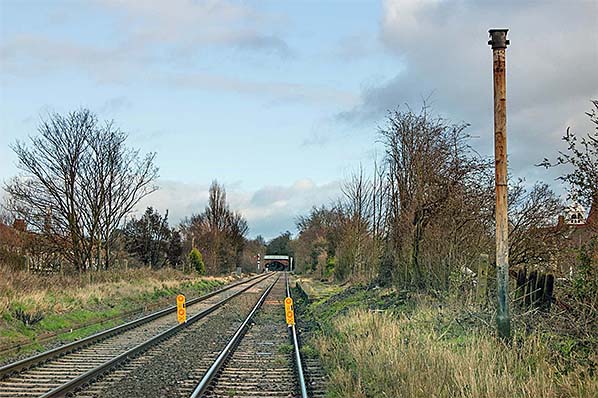
Coundon Road station looking north towards Nuneation in April 2015. Platform remains are clearly seen on both sides.
Photo by Cliff Junes 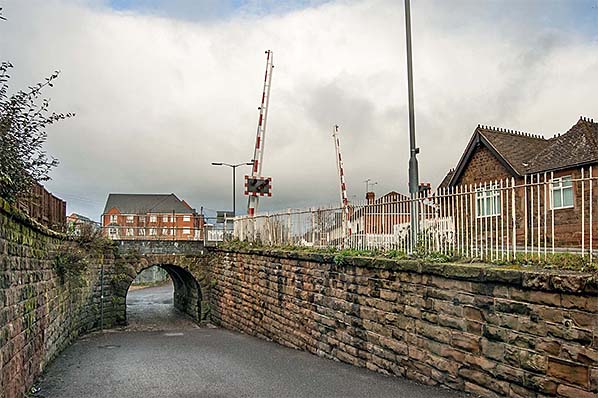
The old farm access lane to used to bypass the level crossing is seen in January 2007/
Photo by Cliff Junes 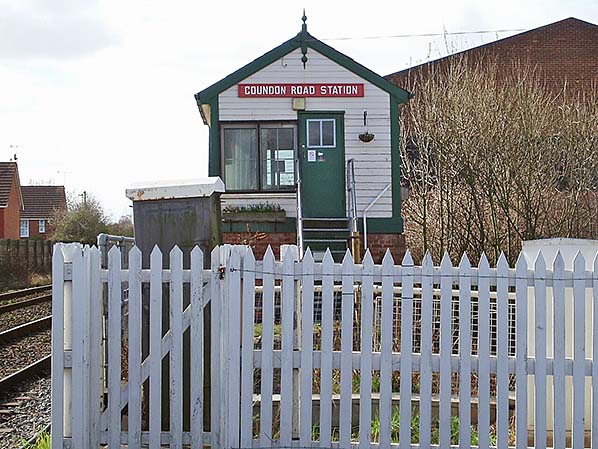 Coundon Road Station Signal Box in 2008. It ceased signalling operations the following year in 2009 after the signalling was moved to the West Midlands Signalling Centre in Birmingham. This was one of the last three remaining signal boxes within the Coventry area to still be manually controlling the level crossings and railway lines.
Photo by Amanda Slater reproduced from Wikipedia under creative commons licence 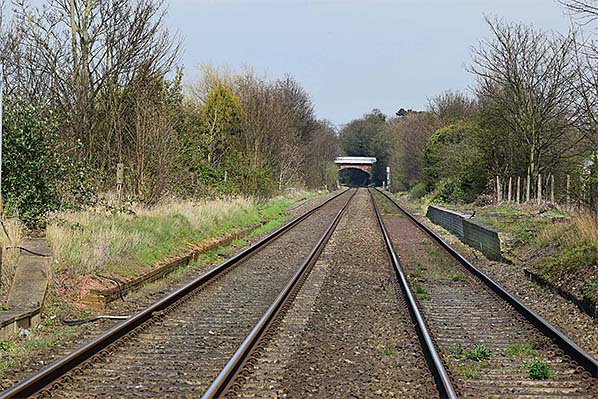
Coundon Road station looking north towards Nuneation in April 2015. Platform remains are clearly seen.
Photo by Cliff Jones road1.jpg)
The station master’s house in February 2026. The building can be seen by the level crossing, behind the large tree. All evidence of the platform ramps and access has been removed. The house now functions as the classics block for the Bablake Junior School.
Photo by Joshua Guest road2.jpg)
Looking north towards Nuneaton, and the platforms at Coundon Road station in February 2026.
Photo by Joshua Guest road3.jpg) The site of Coundon Road station in February 2026, facing towards Bedworth. The Coventry-bound platform can be seen to the right of the photo. The Nuneaton-bound platform is on the left of the photo, although it is less intact due to the metal fencing. The platform edge stones have also been removed from the platform unlike the Coventry platform, which is still visible in the undergrowth.
Photo by Joshua Guest road4.jpg)
A Nuneaton-bound West Midlands Train passing through the Coundon Road Level Crossing and near the former Coundon Road station in February 2026. The line continues to see regular suburban services between Coventry and Nuneaton, and some services extend to Leamington Spa, via Kenilworth.
Photo
by Joshua Guest
road5.jpg)
The line facing south back towards Coventry. The site of the signal box was to the centre-right of the photo, near the tree. Until 2014, the Signal Box was still visible and one of the last surviving railway relics on the Coventry-Nuneaton Line. Despite it being locally listed by Coventry City Council it did not protect it from demolition by Network Rail in 2014.
Photo by Joshua Guest road7.jpg) The site of Coundon Road Signal Box in February 2026. The signal box was located just past the small bridge on the right. where the trees now are. The signal box did inspire Ezra Miles, who was a signalman, to write a book in 2024 titled "The Signalman". It is based on the signal man's work in a rural and isolated signal box. It reflects the feelings of isolation and loneliness as well as the signal man's impassioned dialogue with God.
Photo by Joshua Guest road6.jpg)
The level crossing at Coundon Road in February 2026. The old station master’s house can be seen to the right of the picture. It now forms part of the nearby Bablake Junior School. There is no public access to the building as can be seen by the wall. The level crossing remains one of only a few left in Coventry. The level crossings at Canley and Tile Hill stations were closed and removed in the early 2000s. During the upgrade works of the West Coast Main Line.
Photo by Joshua Guest 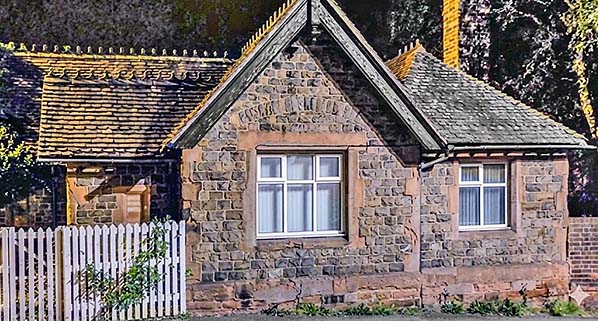
The station master’s house at Coundon Road station. A wall now blocks it off due to it being part of the Bablake Junior School grounds. It is the only surviving station master's house in the Coventry city area. The only other surviving station master's house is at Hawkesbury Lane station near Bedworth in Warwickshire.
Photo by Joshua Guest
|


 Home Page